Guiliano Global Fellows: Studying Grip Strength in Mongolia
Throughout each year, a handful of 91社区 students are selected to complete academic research projects at least 200 miles away from their campus through the聽Edward Guiliano Global Fellowship Program. Since 2014, more than 170 students have had the opportunity to engage in this experiential-based learning that merges academics and culture.聽
This spring,聽College of Osteopathic Medicine聽(NYITCOM) students聽Melody Young听补苍诲听Noah Chernik聽were awarded a grant under the fellowship program and traveled in August to Mongolia to perform research and teach middle school students about biomechanics. Young is no stranger to the fellowship program鈥攕he has traveled twice before under the grant to Costa Rica and North Carolina, where she studied three-toes sloths and collected grip force data from lemurs, respectively.
Alongside Assistant Professor of Anatomy聽Michael Granatosky, Ph.D., Young and Chernik鈥檚 project Across the Pacific: STEM Initiative in Mongolia brought their well-established Are You Stronger Than a Lemur outreach program to the young students overseas, where it became a successful international educational program.
Supported by a聽grant聽from the Leakey Foundation, Are You Stronger Than a Lemur was established in October 2022 as an interactive grip strength activity for K-12 grade students. The exercise is twofold: children learn about the origins of human biomechanics while novel data on human development and gripping performance is collected.
In Mongolia, Young and Chernik had students take a six-question quiz covering topics of biomechanics, muscle physiology, statistics, primatology, and human evolution. A presentation followed, with the budding physicians explaining why they chose to study lemurs as a way to understand grip force in the context of human evolution.
Students then became scientists as they used a dynamometer鈥攁 device used to measure force鈥攖o discover their own grip strength. Data was plotted on a board, and their grip force was compared to lemurs, fellow students, and data from American students. After guiding the children through interpreting their recorded data, they retook the quiz from the beginning of the lesson to assess what they had learned through the experiment.
鈥淚 hope our participating students realize that science doesn鈥檛 have to be hard, boring, or out of their realm,鈥� Young says. 鈥淎re You Stronger Than a Lemur is so special because it turns people who may have never had any interest in science into citizens who are now actively participating in the scientific process. It takes an evolutionary/biomechanical question that we are interested about in the lab and makes it relevant to every single person who takes part in it.鈥�
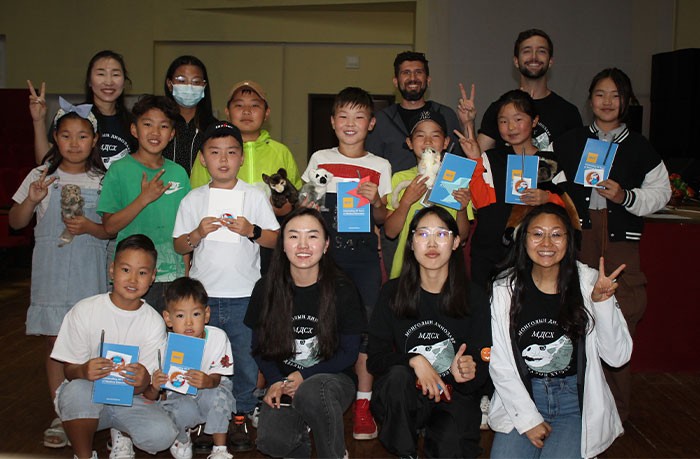
By the end of their time with the middle schoolers, Young and Chernik had collected two sets of data: An assessment of whether their program had objectively taught the students core topics of biomechanics and the actual grip force data they collected using the dynamometers. Chernik believes that, from their preliminary data analysis, they were successful in teaching about science and the greater field of STEM.
In addition to teaching students in Mongolia about grip strength and the scientific method, Young and Chernik also established a pen pal program between NYITCOM students and Mongolian middle schoolers. At 91社区, the duo runs an existing聽pen pal program, where they connect medical students to middle schoolers in New York and Arkansas. Now, the program has gone international.聽
鈥淭his trip was humbling and gave me the opportunity to interact with a people and culture I had no previous experience with,鈥� Young says about her time in Mongolia. 鈥淲e were able to visit traditional nomadic homes鈥�驳别谤蝉鈥�and the people inside; their instinct was always to share and to give. The people of Mongolia helped me feel as though I had a family right there.鈥�
鈥淥ur time in Mongolia allowed me to grow tremendously,鈥� adds Chernik. 鈥淓xperiencing the nomadic lifestyle was eye-opening and allowed me to reflect on my own practices and values. The students鈥� excitement for the program and learning was unlike anything I have ever seen.鈥�
During their time there, Young and Chernik had no knowledge of Mongolian鈥攁 language that, while using the Russian alphabet, is completely one of its own. The pair traveled with two Mongolian college students and an educator, who helped them overcome cultural and language barriers and, Chernik says, exposed them to all the country had to offer while making them feel at home.
鈥淲ith a well-planned and meaningful application, you have a real chance to have a once-in-a-lifetime experience without the financial hardships,鈥� Chernik says of the unique opportunities afforded to students through the fellowship program. 鈥淧ick a passion or interest that you would like to pursue, and then plan your application around that main purpose. It is truly an incredible experience and a chance to perform unique and memorable work.鈥�
The next cohort of students selected for the Edward Guiliano Global Fellowship will complete their projects between December 2023 and May 2024.聽Learn more and apply. Applications due by November 14.聽
More Features

91社区 Awarded $2.5 Million to Advance Civil Discourse on Campuses
91社区 has received the U.S. Department of Education Fund for the Improvement of Postsecondary Education Special Projects Program Grant, which will support efforts to drive student success through building civil discourse across the university鈥檚 campuses.

My Co-op Gig: Marcus Fredericks
Computer science student Marcus Fredericks credits his willingness to experience new things with turning his co-op at 1-800-flowers.com into an ongoing employment opportunity.

Intern Insight: Mohammad Nazim Dawla
M.B.A. student Mohammad Nazim Dawla acquired skills at his accounting internship that he will carry with him throughout his career.