NYITCOM Researchers on the Scent
In a new study, Assistant Professor of Biomedical Sciences听Gonzalo Otazu, Ph.D.,听of the听College of Osteopathic Medicine (NYITCOM), continues to pursue clues that could help explain how sense of smell is impacted in individuals with autism. 听听
People with autism have an 鈥渋nsistence on sameness鈥� and often avoid unfamiliar elements, including new smells and foods, which can impact their quality of life. While many studies have focused on the behavioral features of autism, additional research is needed to help explain its sensory aspects.
Otazu and his research team have been closely following a trail of scientific evidence that could help bridge the gap. In September, the team published a research paper in , which found that the brain鈥檚 neurological processes responsible for smell differed in mice with a mutation in SHANK3, a gene linked to autism. The findings reinforce Otazu鈥檚 earlier study, published in February, which demonstrated the same deficit in mice with a mutation in the gene CNTNAP2, which is also linked to autism.
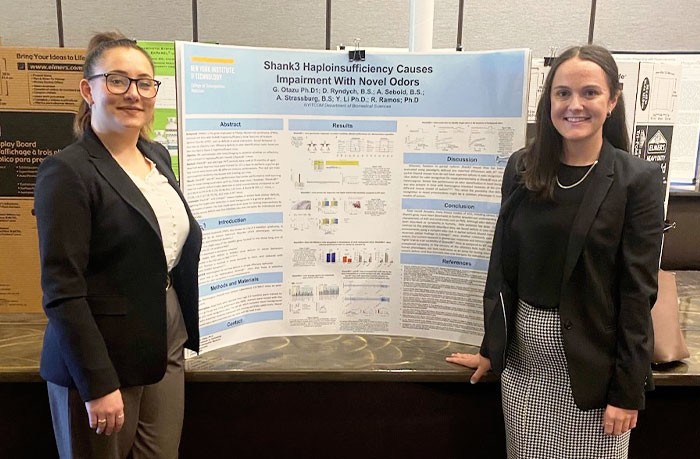
In both experiments, the researchers trained two groups of mice鈥攐ne group with a gene mutation linked to autism (CNTNAP2 in one study, SHANK3 in the other) and one neurotypical group (wild-type mice)鈥攖o recognize familiar scents. Then, the mice were tasked with identifying these scents as new, unfamiliar odors were introduced in the background. While the neurotypical mice were able to 鈥渇ilter out鈥� the new background odors and identify target scents, in both studies, the mice with the gene mutations linked to autism struggled to do so.
In their latest paper, Otazu and his co-authors write:
鈥淧eople and mice with mutations in a single copy in the synaptic gene SHANK3 show features seen in autism spectrum disorders, including social interaction deficits…Here we used a recently developed task to show that these mice could identify odors in the presence of known background odors as well as wild-type mice. However, their performance fell below wild-type mice when challenged with novel background odors. This deficit was also previously reported in the CNTNAP2 mouse model of autism, suggesting that odor detection in novel backgrounds is a general deficit across mouse models of autism.鈥�
The SHANK3 study is also gaining attention outside of the laboratory. Two NYITCOM students involved in the research, Darya Ryndych and Alison Sebold, recently shared the team鈥檚 findings in a poster presentation at a New York State Osteopathic Medical Society conference, where the duo won first place in the event鈥檚 poster contest.
Other collaborators involved in the study included NYITCOM student听Alyssa Strassburg听and Associate Professor听Raddy Ramos, Ph.D.
More Features

Bear Bytes Initiative Supports Students鈥� Holistic Health
At 91社区, leaders recognize that access to healthy food is one of the most fundamental drivers of success.

Supporting Children with Autism
For Autism Acceptance Month, Associate Professor of Occupational Therapy Alexander Lopez, J.D., OT/L, shares practical guidance to help parents better understand how to support children on the spectrum.

Match Day 2026: The Road to Residency
NYITCOM鈥檚 Class of 2026 joined thousands of soon-to-be physicians across the country in discovering where they will complete their residency training after graduation.